 Khojipedia
On November 12, NVIDIA announced that co-founder Jensen Huang had resigned as president, CEO and director after 33 years leading the company. The board had accepted his resignation the previous day, according to its SEC filing. The board appointed longtime finance chief Colette Kress interim CEO while it searches for a permanent successor and named director Harvey C. Jones its first board chair. Kress remains CFO, a position she has held since 2013.
Investors gave the new leadership team little time to settle in. On announcement day, NVIDIA traded as low as US$148.80 before closing at US$166.19. It closed Friday at US$162.85, down roughly 13% for the week. One estimate put the loss of market value at about US$900 billion from the previous Friday’s close to Thursday’s intraday low. That comparison includes the selloff before the announcement and ends before the partial rebound. The question for customers is whether a leadership transition changes whom they trust to supply their next data centre. The question for investors is how much of NVIDIA’s pricing power can survive it.
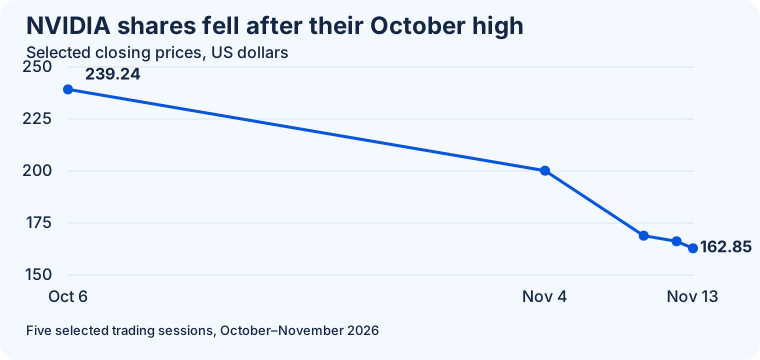
Selected closes in U.S. dollars. The chart connects five observations and does not show every trading day. Historical prices and October record-close reporting.
Why NVIDIA still holds the high ground
NVIDIA’s GPUs perform many calculations in parallel. That makes them useful for training models on large datasets and for inference, the work of running a trained model to answer a question, analyse an image or generate code. As models get bigger, chips have to exchange information quickly enough to keep working. Buying more processors delivers little if they spend too much time waiting for data. NVIDIA’s NVLink connects GPUs within a system at high bandwidth. Other networking products connect systems across a data centre. NVIDIA can sell the accelerators, the connections between them and software that helps operate the cluster.
CUDA is the software layer that makes that hardware especially valuable. Developers have spent years building libraries, optimized routines and debugging tools around it. A machine-learning team that moves a production service has to check which components already run on the new hardware, rewrite those that do not, and validate the results. It also has to test latency under heavy traffic and train staff to handle failures. A successful demonstration may take days. Qualifying a complicated production service can take much longer, especially where uptime or regulatory requirements matter.
That is microeconomics at the buyer level: a team compares the total cost of delivering a useful result. An accelerator that rents for less per hour can cost more per task if it needs more hours, draws more power or ties up engineers for months. Conversely, a rival can win if the workload runs reliably at a lower cost and migration is manageable. Customers with large recurring workloads have the most to gain from doing that arithmetic carefully. The savings on each request may be small, but they add up across billions of requests.
Kress brings continuity as customers make those calculations. Reporting cited by Axios says she questioned how NVIDIA should value customer-financing guarantees and assess returns. That history is relevant as infrastructure customers seek help funding large projects. An order funded partly by a supplier may accelerate deployment, but investors will want to know who absorbs losses if the buyer cannot fill its data centre or secure more financing. Kress’s experience gives her a basis for answering that question at the November earnings call.
The opening for rivals
AMD’s Instinct accelerators give cloud operators another supplier for training and inference. AMD is also developing rack-scale systems with its own CPUs, networking and ROCm software. That strategy matters because a cloud operator needs the whole rack to work reliably. A second supplier can reduce dependence on one roadmap, offer leverage in procurement and help fill capacity where one supplier cannot deliver on schedule. A buyer might keep its most complex training jobs on NVIDIA and pilot a well-understood inference service on AMD.
Google Cloud’s TPUs pose a different challenge. Google designs the accelerators and can rent access through its cloud. Buyers can use a TPU where their model and software fit without having to buy or operate the hardware themselves. Large cloud providers can also direct some of their own demand to in-house chips. Every workload they run that way reduces the amount of external capacity they need to buy for that use case. Portability and access to capacity in the right region still matter to customers that want the freedom to move.
Huang’s exit gives these suppliers a chance to open procurement conversations. Founder-led relationships helped NVIDIA sell multiyear roadmaps to hyperscalers and governments building domestic AI capacity. A leadership change can prompt buyers to ask who will make commitments on delivery, support and future pricing. That gives rivals an opportunity to sell a pilot or win a portion of an expansion. It takes much more to win the whole contract. The buyer still needs enough chips at a predictable delivery date, software that works with its models, and engineers who can diagnose failures at scale.
For a procurement team, a useful comparison starts with its own workload and sets the same service targets on each platform. For a customer-support model, for example, compare cost per thousand acceptable responses when traffic peaks. Include downtime, engineering support and any fees for moving data. An accelerator with the best benchmark can lose that comparison if the buyer cannot reserve capacity when it needs it.
Macro headwinds and geopolitical risk
The resignation came amid reporting about Huang’s personal relationships, including an alleged undisclosed workplace relationship and a relationship with a former executive of Singapore-based Megaspeed whom reports have linked to Chinese intelligence. Associated Press reporting describes the scrutiny over potential diversion of advanced chips to China. Reported purchases worth billions of dollars and the value of any chips shown to have been diverted are separate figures. A House committee letter requested a closed-door briefing on November 18. The letter establishes the request. It leaves the timing and eventual findings open.
Export controls affect who can buy advanced AI chips and can raise compliance costs for distributors and cloud providers. The other constraints sit in the physical economy. Building a data centre takes land, financing, transformers, cooling equipment and a reliable grid connection. Higher borrowing costs raise the revenue a project needs to cover its financing. A utility connection delayed by a year can postpone demand for chips even when customers want computing capacity today. A tighter market for electricity can also keep operating costs high for rival accelerators as well as NVIDIA’s.
For Canadian businesses renting cloud compute, more suppliers could improve availability and give providers room to cut prices for training and inference. How much of that reaches the customer depends on competition among cloud providers, grid capacity and the Canadian dollar, especially when compute is billed in U.S. dollars. A cheaper chip helps most when a provider can deploy it nearby, keep it busy and pass the savings through. A buyer comparing Canadian and U.S. regions should also account for where its data must stay, what it costs to transfer and how quickly the service needs to respond.
There is also a timing mismatch between the economics of the grid and the economics of software. A business can roll out an AI feature in months, while a utility may need years to add capacity. Cloud providers can respond by rationing access, shifting workloads to regions with spare power or charging more for guaranteed availability. For a smaller company, keeping a cheaper model ready for routine requests can cut exposure to those prices while leaving expensive compute available for jobs that actually need it.
What to watch next
NVIDIA’s November 17 earnings call is Kress’s first scheduled results call as interim CEO. Management had forecast US$108 billion in quarterly revenue, plus or minus 2%. The quarter ended October 25, before the departure. Forward guidance, delivery schedules and any changes to financing commitments will reveal more about the transition than the headline revenue figure alone. Customers will also want to hear who is accountable for keeping product launches and support commitments on track.
The second milestone is the permanent CEO selection. Succession coverage has discussed CUDA architect Ian Buck internally and floated Arm CEO Rene Haas and AMD CEO Lisa Su as outside possibilities. Those names reflect public speculation while the board conducts its search. A technical insider could signal continuity for the GPU and software roadmap. An external hire could bring a different approach to governance, financing and customer relationships.
Huang spent 33 years making NVIDIA indispensable to AI developers. The institution he built now has to keep earning that position with every chip generation, delivery and renewal.
Sources
- NVIDIA’s CEO transition announcement and SEC filing cover the resignation and interim leadership.
- NVIDIA’s quarterly guidance and November 17 earnings call notice establish the forecast and reporting date.
- Historical share prices and Euronews market-value reporting provide the market context.
- AMD Instinct and Google Cloud TPU documentation describe rival hardware.
- The House briefing request, Associated Press reporting and Axios succession coverage cover the regulatory and succession context.
Fact-check note
As of November 14, 2026, NVIDIA had announced an interim CEO and an ongoing search for a permanent successor. The US$108 billion figure is company guidance, with a range of plus or minus 2%. The roughly US$900 billion market-value estimate compares the previous Friday’s close with the November 12 intraday low. The chart uses selected closing prices. The House letter requests a briefing. The reported relationships, possible chip diversion and names floated in succession coverage should be read with their original attribution. Potential cloud cost savings are an economic scenario.
Key takeaways
- NVIDIA’s GPUs, networking and CUDA raise the cost of switching suppliers
- AMD and Google can win workloads where they deliver lower costs at the same service level
- Watch Kress’s November 17 earnings call for delivery, financing and guidance updates